Friday, July 1, 2011

Teaching

The finite elements text.
As part of the exchange I am on I taught for a semester. I like teaching, so this was something I looked forward to, although during my first semester here I appreciated time away from teaching. It's always fun to meet a new group of people, and good students force you to understand the material well. I also looked forward to meeting more Africans, as well as teaching some course material I had not taught before. I'll comment on the differences in the teaching format and students between University of Montana and University of Cape Town.

C++ was taught from this text.


First, at UCT it's not uncommon to have two instructors take responsibility for a single course. Each then gives half the lectures, and develops half the assignments and exams. I entered into a couple of these relationships, one for a course in C++, and another for a introductory level finite elements course. This was good and bad. Just when I felt like I was getting to know the class, I stopped teaching. In this way, I don't think the students ever really caught on to what a charlatan I am, which is good. Then again, I never got to know some of them very well, which was bad. I enjoyed working with another instructor, but it was occasionally awkward to be so mixed up in one another's teaching.

The system here favors a final examination amounting to some 60% of course points. The process is highly formal with external reviewers looking at the exam itself, making sure the test is fair, and that it is graded in a consistent manner. The exams are three hours long. All of this meant for a busy week, preparing exams in time to get them off for external review before the end of classes.

Sitting for final exam in Finite Elements.
Students here were a delight. I enjoyed meeting people not just from South Africa, but from all over Africa. I had students from Tanzania, Uganda, Botswana, Nigeria, Mauritius, Lesotho,  as well as all over South Africa. I also had recent immigrants to South Africa from Italy, Bulgaria, and Bosnia. I truly love the diversity that I experience here. This institution draws the finest from all over Africa, and beyond, and it's a pleasure to try and instruct them.

Outside of the wonderful assortment of backgrounds my students came from, the other most striking difference was the standards that are applied. 50% is a pass, and at about 75% one can be awarded a distinction, but that's not a primary concern. Hence, when designing assignments and exams, you make them much tougher than I would in the US. The students are used to taking a beating. Exam questions I know I'd have been hassled about the 'fairness' of in the US were received without comment. In the end, I fear I may not have been such a hard teacher, the years of writing tests targeted at about a 70% average was a hard habit to break.

A student's version (left) of my notes (right).
Finally, the system stresses hand writing at all stages. I know my boys were taken to task about this at primary school level. I thought it would be fun to show a picture of just how tidy some of the student's notes are.

Sunday, May 22, 2011

Mom's visit

The deck of the house we rented.
My mother visited over the Easter Holiday. In terms of living abroad, one great pleasure is to host a visitor. You can show them a few of the places you've fallen in love with, and reconnect with what you really are in terms of family, nationality, and culture. I think we are getting better at enjoying ourselves here. Rather than set out on an ambitious agenda of site seeing, we picked a few nice things and settled in for a relaxing stay. I was also happy that mom got to have a look at the boy's school, and see how things work there a little bit. That's a huge part of this experience, and often overlooked when confronted with the vast assortment of tourist options.

Brenton on the Sea beach, near our rental house.
We stayed a few days in Cape Town; she saw the wineries at walked through the vineyards. We ate at some nice restaurants, and watched the boys play soccer. After that we headed for the Garden Route, a lush coastal area of South Africa, about 4 hours drive east, along the coast. We rented a nice house, and made modest little trips out in the day. Walking on the beach, visiting an elephant sanctuary, walking through the forest, and doing a zip line tour of the canopy. Perfectly unambitious for a 5 day stay.

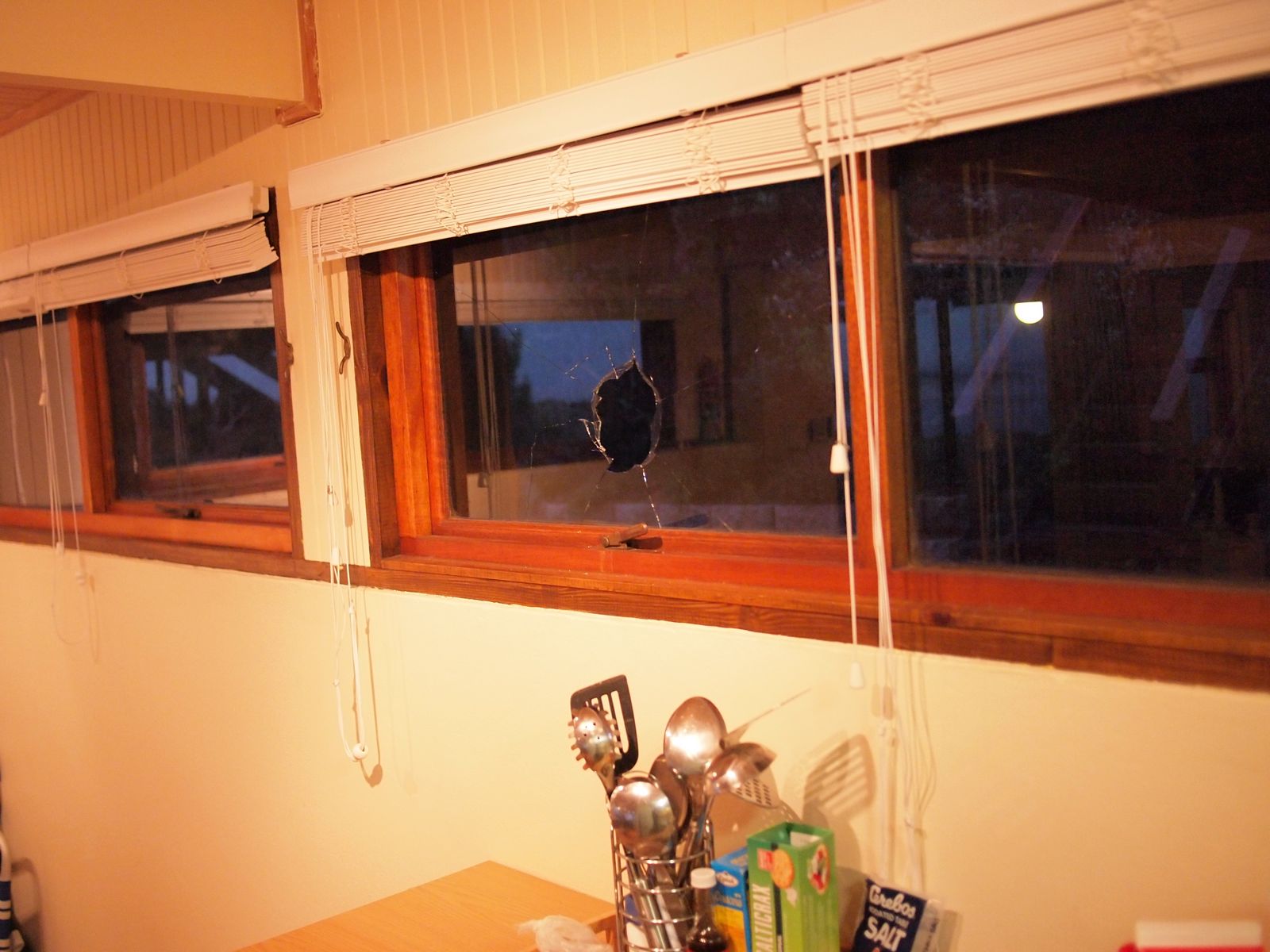
The broken window.
Canopy tour.
I should write about the crime that occurred; sadly, it is part of South Africa. As the photos show,  we were in a very comfortable place. The house was in a wealthy area, and seemed isolated from the poverty that is so common here. I had been warned, and generally know better, but feeling comfortable, I tossed my wallet, sunglasses, and cell phone on a counter near a window before going to bed. Around 5:45 the next morning, while we laid in bed listening to the birds and the surf, we heard the window smash. I got up and started shouting, hoping to frighten off whomever might be in the house. There was glass everywhere, I was barefooted, pacing back and forth, trying to find some shoes to put on. It was a scary morning. Who ever broke in was a timid sort, and did run off after they had taken my things. I didn't even realize I had lost those things until later, when we prepared to leave for the day. We spent the morning on the phone, calling police, security, credit card companies, etc. etc.


Elephant feeding.
Generally, the police and private security people were good. Competent individuals that see plenty of this sort of thing. The term for what we experienced is "smash and grab", and it happens in that area (according to the person that replaces windows) about 3-4 times a week! Perpetrators are non-violent, and sometimes items are recovered along the train tracks that run between the upscale housing and the townships. Something I'll never forget is the footprints around our bedroom windows. They'd looked into all the windows before committing the crime. They were bare footed.

Zach on a sunset cruise of the bay.
Anyway, the crime lowered our spirits for a day or two, and made us a little paranoid in our beautiful beach home.  We made the best of it and had a lot of fun. Ours is a common story in South Africa, everyone here has a similar story, and many of them are worse. Sooner or later I'll have to tackle what I think the future might hold for this place, but today is not the day.


Grandma and the boys.

Saturday, May 21, 2011

Wild Animals

Begin looking for game before sunrise.
As we prepared to leave for South Africa, the most frequently asked question was about seeing big game. I suppose its part of the romantic ideal of Africa; sleeping under a mosquito net in a candle lit thatch roofed hut, a purple sky out the window, silhouettes of giraffes near the watering hole... But how does it stand up, really? Cynics say that a game park is little better than a big zoo. Where there is wildlife, there are traffic jams, people lean out of over-sized 4x4s with jumbo camera lenses, trying to get that special shot of a lion. The climate is too hot, the air is too dusty, there are loads of nasty insects, you'll get malaria, the food is terrible and overpriced. And on it goes.

Hyena in the morning mist.
None of these rumors deterred us from going, but we were psychologically prepared for a let down. We set decided on Kruger National Park, South Africa's largest. It's far to the north east of Cape Town, in a wetter, more tropical environment.

So, how was it? There is nothing that can prepare you for the spectacle of the African bush. Life there is lived and lost on a scale that is unlike anything else. The juxtaposition of super-abundance and deadly competition generates and dizzying edifice to evolution that you can easily spend the rest of your life contemplating.  Independent of seeing a single animal, the climate, the vegetation,  and the landscapes make the African bush a worthwhile destination.  And then the animals... they are terrific. Unless you've got an undersized soul to go along with your over-sized 4x4, you will enjoy being in a place like this.
The buffalo have soulful eyes.

Vegetation excites the imagination.
Logistically, it's not hard. You fly to Johannesburg, and then travel about 5 hours by car. The roads are good, even in the park, and there is no real need for anything more than a economy car. That being said, it was nice to ride a little higher, to see more, so we rented a small SUV.  The quality of accommodation was hard to guess in advance. There are a large number of private and semi-private concessions around the park, and  South Africa National Parks accommodation inside. The question becomes; is it nicer to stay in the park, where accommodations might not be as nice (drab 'gubmint' housing), or stay outside where you're removed from the action, but in the lap of luxury? In our case, I think the answer was to stay in the park. The accommodations are not lavish, but completely adequate. Tidy little roundavles, with a shower, air conditioner, and two beds.

Food was fine, and there were choices aplenty. There are effectively grocery stores in the park, and the premium for purchasing food in the park is minimal. The restaurants are fair, as are the prices. The sites are some of the more beautiful locales of the park; with commanding views, and real proximity to animals. For example; a hyena patrolled the fence outside of our roundavel in Satara, and Oliphants had one of the best views of a river basin I've ever experienced. As I write, I long to return, ache maybe a better word.  So, unless you want to live out an expensive (but popular!) fantasy of being pampered on an African savanna, the SANP accommodation is the way to go.

The birds are fantastic.
Voortrekker monument.
I'll let the photographs tell the rest of the story.

One final note, we returned to the airport by way of Pretoria, where we visited the Voortrekker memorial. This nation building myth, like those of most young nations, features courage and strength in the face of adversity. The Voortrekkers set out in about 1840, crossing the interior of Africa to escape British tyranny, and overcame African treachery to found a new nation. Their story is told in Italian frieze on the walls of the memorial, which was constructed from 1938-1949. This founders myth was a corner stone of  of the apartheid regime. Architecturally, as you might guess from the dates, it is somewhere between Mormon and Nazi. I'd suppose I'd describe it as a church in need of worshipers. Better it stays that way. Well worth the trip, these relics of powerful ideology remind one of just how crazy people can get. Please never let me or my country become crazy.

Concluding, it was a fantastic trip, I recommend something like it to everyone. We will return to the bush in July, when we go to Namibia. I hope it continues to thrill us, the way Kruger thrilled us.

Sunday, April 17, 2011

What's happening?

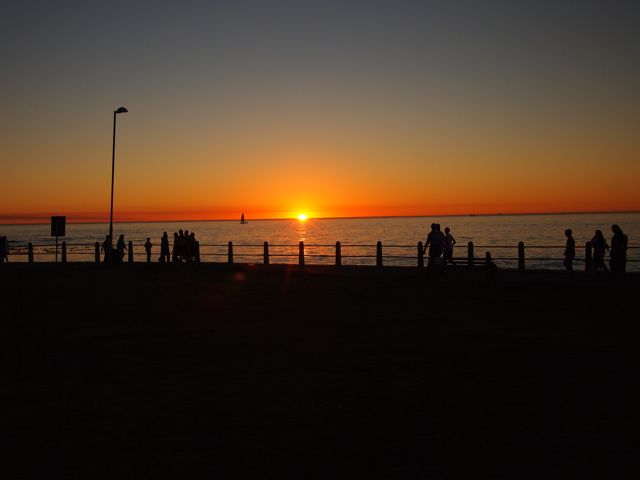
Will this be the last gorgeous sunset? No, but its close.
I'm teaching now, and the boys are in school. The days are spinning by, and the blog is quiet. What a short time ago was a new adventure, has simply become our lives. We've moved to a new and more comfortable house. There seems an inexhaustible supply of social, cultural, and scenic events to attend.  There's a growing sadness that our time here is coming to an end. And, we are busy; commuting, playing cricket, art clubs, chess tournaments, running... Against this background I prepare an entry that I've been planning for a while, but afraid of.

As you can imagine, the legacy of apartheid is a significant part of modern South Africa. To read the papers here, is to step into deep water. You find a large cast of characters, moving across stage littered with historical artifacts. Dramatic tension is delivered by economically dominate ethnic minorities, living in a paradise stained with violent crime. Nearly all these stories are new to a typical American. Well, that South Africa is a country and not a continent is new to a typical American. Instead, say that one can consider themselves informed, and still find South African current affairs perplexing.

Never-the-less, to ignore the happenings in this country is to eliminate one of the my major reasons for coming; I'd like to know what's happening, post-apartheid. With that in mind, I'm sitting down with a typical newspaper, although I confess that I've been waiting almost a month for a 'typical' paper. Too often the paper is consumed with something so hopelessly complicated, I dared not try and explain it. Or it's just about cricket, which I'm also at a loss to explain.

I'll try to relate the contents of several articles in terms that a non-South African can understand. Apologies in advance to all the erudite South Africans who will scoff at my naive interpretations. I'm reading the weekend edition of the Argus. It seems to be a good seller, and is available everywhere.
Front page news.

The lead story this weekend is Protests hit Cape Flats. The flats is a large area south east of Cape Town, designated during apartheid for non-white residents. It continues to be a home for the economically disadvantaged. In the flats and similarly impoverished areas of South Africa, a very hot issue is what is called delivery of services. This phrase is applied when discussing the quality of all forms of government service to communities, for example; electricity, water, sewer, trash collection, schools, roads, and policing. To understand the delivery of services, one has to go back to 1994, when there was genuine optimism about the changes that would come with a democratic society, and a more equitable distribution of government resources. My sense in that many believed that government would spend money improving the areas where they lived. This was seen as being an issue of fairness at the deepest level, South Africa had moved from being a nation that served the interest of 20% of the population, to one that served everyone's interests.

Some 17 years have passed, and in that time there have been significant improvements in many of the communities that suffered from neglect under apartheid. New schools have been built, roads paved, electricity provided, teachers hired, police forces expanded, etc. A new problem has emerged from the new found freedom of movement within South Africa. Economic migrants of come to wealthier areas, such as Cape Town. Naturally, these migrants put a strain on the ability of government to provide services, as what are called informal settlements spring up across the unsettled areas of the Cape Flats. As time passes, residents of informal settlements demand services. Some informal settlement have existed for at least 15 years, and the protests have been gaining momentum for the last 6 years.

In the nine months I've been here, front page news about delivery of service protests has been coming at a rate of about one every few weeks. The photos associated with these stories are often lurid and frightening, like the one posted here. Smaller incidents seem to occur almost daily, with a short note about someone injured in a protest buried deeper in the paper.

Recently, probably due to the elections that are coming in about a month (May 18th), there have been more delivery of service protests. The protests have become more intense, with burning of tyres, looting, toyi toying, blocking traffic, and violence. Key points in today's article are:
  • Electricity has been turned off to residents of an informal settlement. 
  • The electricity had been delivered via lines that were illegally strung from government built houses in a neighboring informal settlement.
  • The electric company claims that the power was turned off by the people living in the houses that the electricity was being stolen from. The protesters claim that the electric company turned off the power.
  • The electric company points out that such schemes involving the theft of electricity with adhoc networks are very dangerous, and illegal.
  • Protesters counter that burning kerosene to light derelict shacks in also dangerous.
  • Protesters also point out that they are unemployed, but operate small businesses, which require electricity and refrigeration. 
  • This informal settlement has existed for 11 years.
  • Police responded forcefully, and calm was restored within 5 hours.
All of this is closely tied to the lead stories on page two of the paper; Police retain weapons, and Town's residents united in protest, which are about the aftermath of a police crackdown on a delivery of service protest in Ficksburg (in the Free State) that lead to a protester being shot and killed by a police officer. The weapons retained are those of the officers suspected of shooting the man. The town's residents are united against police brutality. There is amateur video of the events leading to the shooting. This protest was about delivery of service, primarily water in this case. This is not a case where the settlement is informal, but a township outside of an existing community. The community appears affluent, with a terrific web site for tourists. This remains very common in South Africa, affluent communities with good delivery of service, and surrounding, historically non-white townships, where conditions are bad. I live in just such a place.

Another thing might be involved that is worth relating. The African National Congress, the party most closely identified with the struggle against apartheid, the party of Nelson Mandela, and overwhelmingly the ruling party, selects elected representatives at national or regional conventions. Which is to say that you vote for the party and not the person. The party determines the person. Many communities dislike this intensely, but for lack of credible alternative continue to vote ANC. Indeed, ANC has a lock on power in this country unlike any majority government we've see in the United States. I reckon that people would like a representative that they know, rather than one that is appointed to them. Certainly this plays a part in the anger fueling the protests, if you watch the video, I believe that you see protest signs to that effect.

The second article, about the residents united in protest, goes on to reveal some of the forms that the protest is taking. A library was burned, municipal buildings sacked, and shops looted.

The weekend Argus: it's got sizzle.
There are other, less depressing things in the newspaper. For instance,  on the eve of the elections, there are new political parties forming. One of the more entertaining has to be the 'Dagga Party', who's members encourage the electorate to 'listen to the herb'. Another party, the Cape Party, is seeking any and all constitutional means for the Western Province to secede from the republic of South Africa. That is a big deal.

South Africa is about to have its first African Playmate in Playboy magazine. The Argus has more salacious content than the other papers, and manages to find a story like this every weekend. "Bootiful", I wonder if that's funnier to dagga party members?

In this part of the world, the English Premier League football players are the sports stars. Just ask my kids. These guys are not only amazing athletes,  they also seem to lead the sorts of lifestyles that only an attorney general of New York might aspire too.

Cape Town is in the running to become one of the 7 natural wonders of the world. This would bring a lot of tourism dollars. Is it more than just a marketing gimmick? Absolutely, this place is a natural wonder. Come if you can. Nine months in, and I still feel we haven't even scratched the surface of what is here. We discover new delights every weekend.

And, finally, I'll conclude with the story of Shrien and Anni Dewani. They were honeymooning in South Africa in November 2010. The couple decided to investigate a highly recommended, and colorful eatery in the Cape Flats. At this point, facts become a matter of dispute. According to Shrien, the hired vehicle they were in was car-jacked. Shrien got out, and his bride was driven away and murdered.
Nothing like this crowd to bring on a giggle.

We were in South Africa when this happened, and the spirit of the country was really troubled. This was a beautiful couple and for her to have died so senselessly reflected poorly on the status of modern South Africa. However, police quickly found the murderers, and they claimed that Shrien had paid them to kill his wife. Police also traced cellular phones, and records of conversations and text messages between Shrien and the killers.

There are other twists in the story that don't have the same credibility as the facts above, but are interesting. Another unsolved murder took place involving an associate of Shrien's in South Africa. Shrien was known to have been in South Africa at the time. And, a U.K. based male escort known as 'The German Master', and having a fondness for leather apparel, has publicly revealed a relationship with Dewani.

The Master. Screaming for vengeance?
Shrien has been in England, fighting extradition to South Africa since January. His dramatic manoeuvrings have kept the press (and me) interested in the story. I think his basic argument is that his health is too frail to face trail in South Africa, and that the South African justice system is barbaric. I'm not quite sure how the British legal system is supporting him on this. I think he is just delaying the inevitable with appeals, exercising due process.

This week's story is just more of the same. As part of his bail agreement, Shrien is now in a mental hospital where he is being evaluated in some way. His behavior there has been erratic and volatile, and he's running out of options for interment, as the authorities at the facility would like him to leave. The judge is involved with the question of where Shrien can go until the extradition case is resolved. Shrien collapsed while leaving the court house.

Phew, that was hard. Perhaps I'll strive to make more, less challenging posts in the future. Note, there are some photos of a recent trip to Kruger in the upper right corner of the blog. Have a look.

Sunday, January 30, 2011

Happy New Year

Back to school!
Happy new year to all. Presently, we find ourselves having finished five weeks of holiday. Now back in Cape Town, we've returned to school and work with a renewed sense of purpose. Five weeks was long enough to peer into the abyss that lies beyond this mortal coil. Naively one wishes for the unlimited beach and all that is associated with it; fine sunshine, cool water, rich feasts, care free days, play, and, allegedly relaxation. But when life delivers on this, experience begins to diverge from fantasy. One (or at least I) begins longing for the dull routine of work. The familiarity of surroundings and social contacts. The sense of accomplishing something, even if that something is make believe. In the end the experience was, if you'll indulge me; crystalline fragments of pure bliss, embedded in a gooey substrate of idleness. A summary follows.
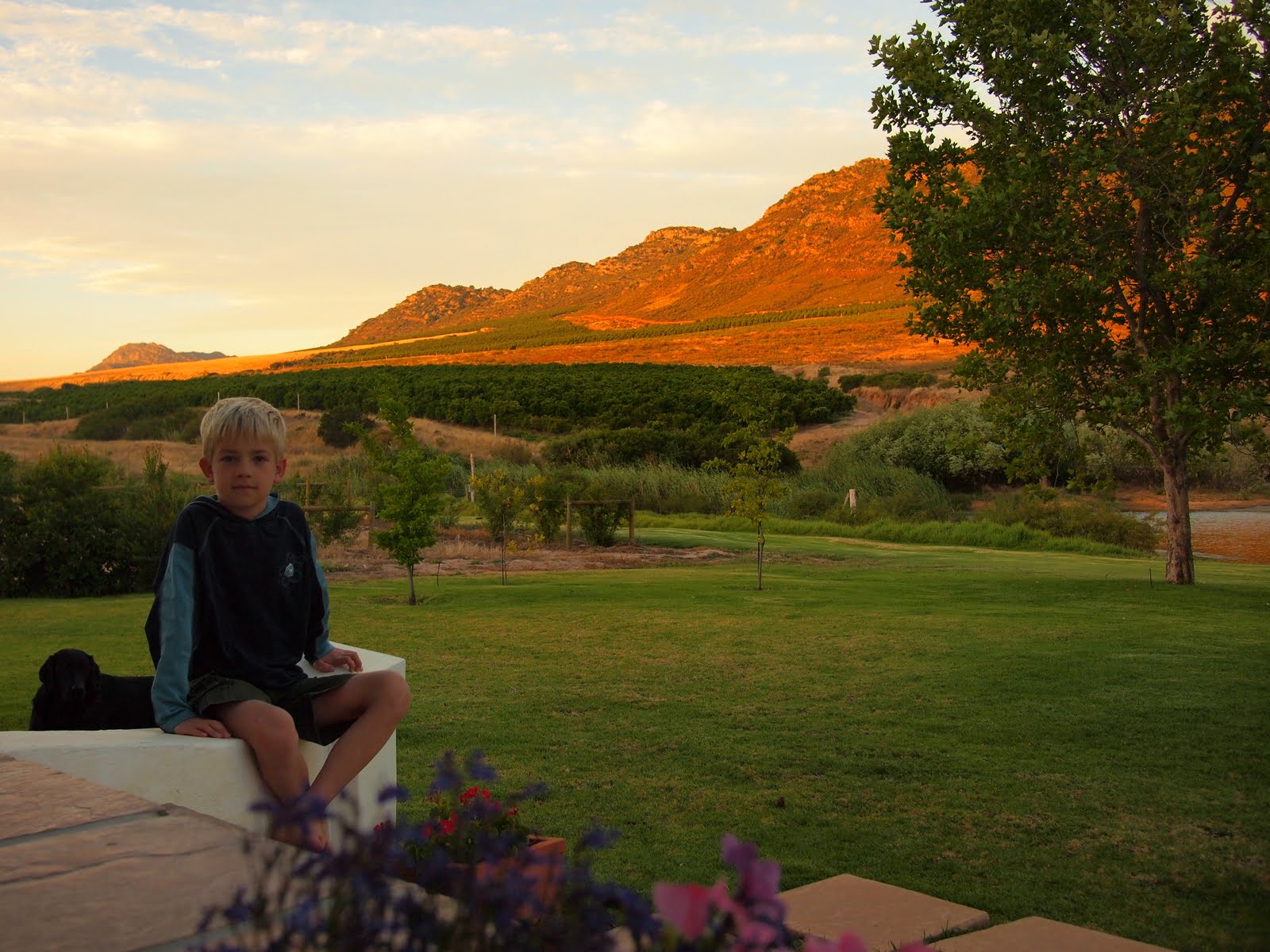
The Vermont cottage lies behind the dam and to the left.
Last you read, we had been to stay in a cottage in Citrusdal. Upon leaving there, we moved our life to a small town called Vermont. Named after the green hills visible from the town, this community is largely the result of the sprawl of beach homes that stretches out from the very popular resort town of Hermanus. We found an affordable cottage on a 'small holding' or estate of several acres in size. On the property, there was a small dam for swimming, and an enormous 'garden' (used the way we use 'yard') for playing.

Zach on the rocky coast near the cottage.
From our cottage, it was easy to walk to the coast, which in that area has a rocky, but attractive quality. Many small and fascinating creatures can be found in the pools left in the rocks at low tide, and kids carry small nets on the ends of sticks. 6 kilometers of well maintained coastal path made the morning jogs some of the best I've had. The area is very Afrikaans, and trail users greet you with a terse, 'mor-a'.

A short distance away from the cottage there were beaches with good swimming. One of our favorites was Ornus beach, where the Ornus river meets the ocean. The ocean can be intense, with its cold, powerful waves and stinging salt. A warm, fresh river to soak in was sometimes a welcome change.

Swimming in the ocean at Ornus beach.
We idled away the days on the beach, and occasionally would move inland, to some well developed hiking trails on the Fernkloof nature reserve. The wild flowers were putting on a good show, and we enjoyed a couple of pleasant walks.

As an indication of the social milieu that develops around a family spending so much time together, our most memorable experiences involved meeting friends who were also in the area. We hiked a few miles along a river to a secluded and refreshing swimming hole. We also did some horse back riding, and had a nice lunch with other friends.
Fernkloof flower; lanaria lanata

Another social outlet was provided by the owners of the cottage, who had us over on Christmas Eve. We had a fine evening, in what seemed to be a uniquely South African way. The dish that was most desired was the corned beef tongue. The family was Afrikaans, and very committed to the betterment of the country: running a charitable organization that promotes English literacy in Xhosa speaking families. They showed us the sort of hospitality that we've come to think of as normal here, but I still marvel over when I take a moment to think about it.

Hiking above Hermanus at the Fernkloof nature reserve.
Christmas itself was a quiet affair, with a few gifts, and, at Abe's insistence, some of the saltiest ham (called jammon here) I've ever had. Curiously, I think ham (or salt?) in those dosages can be something of a stimulant. I couldn't sleep at all that night.

Finally, our time there ended, and we returned to Cape Town to collect my father, who made the  long trip form South Dakota. So began another long and indulgent adventure, this time with more money being spent.

Abe climbing on rocks at 'Breakfast beach'.

We spent a few days in Cape Town, seeing the things that most agree one should see. This was somewhat tiring, as there is a fair amount of driving involved in going to all the sites in a few days. I think it was good, but I'm sure dad was mostly in a haze of jet lag.

For us, the trip took a turn for the better when we went to Franschhoek, and settled in for a few nights. Once there, our driving time was reduced to simple jaunts for meals or wine tasting. There was more time to relax and read, or enjoy one anothers company. I caught up with dad on some family business, and eagerly participated in his favorite pastime, arguing. Dad involved himself in the poolside tomfoolery that 7 and 9 year old boys invent.

Dining in Franschhoek.
I'm told by South Africans that Franschhoek has become an internationally recognized center for cuisine. I agree. Everything was superb, and the pairings of the wines with foods really adds to the enjoyment. I've never had it so good, I'm starting to think of wine as a staple, like bread. Always seeking to diversify the list of things I have consumed, I made some odd choices on the menus, opting for the suckling pig, and the lamb's liver. They were good, but it did seem that others did better with more conventional choices. Ah well, how many people can really say that they have experienced the finest liver possible? If you're curious, it still tastes like liver.


Waenhuiskrans, or (covered) wagon house cave, Arniston.
Dad's trip concluded in Arniston. Our friends  suggested we come and visit them at their cabin there, and experience the delights of the 'Arniston hotel and spa'. It was a very good suggestion. Arniston comes as close to some beach ideal as it gets, I guess. Very few people, very good service, warm and calm waters for swimming. I sort of get it, understand why people get so excited about this. But I still haven't figured out what I'm supposed to be doing at a beach resort.

Dad looking for octopus.
And that, friends, is all. You're very patient to make it through this account, I think it's more for my own memory than something people would be interested in reading. But, it was getting to be time for another post, and the holidays are the obvious thing to discuss. Soon I'll be teaching, and the daily events will be worth relating.

Monday, December 20, 2010

Christmas 4th of July Beach Party Mashup

Abe receiving his award at the end of year ceremony.
Abe and Zach began summer break two weeks ago. This was preceded by a week of the hearty self-congratulation that private schools excel at; picnics, awards ceremonies, and galas. On the whole, I still find it all pleasant. The weather has eased into a smooth trajectory through warm sunny days and cool nights. The holidays are coming, there's a certain buzz of familial emotion in the air. Shops are stocked with specialty meats, fudges, puddings, and cakes. The campus is abandoned, and the streets of Cape Town have lost some of their manic energy. The youth wear small clothing and big sunglasses. Somehow, all of this is familiar, but is triggering memories from several different times of the year, and at least one show that I saw once (ok, twice) on MTV. What was Jesus thinking, arriving on the longest day of the year? Right now, I'm having a hard time reflecting on anything deeper than my tan.

Leisure, here we come!
As pleasant as this backdrop may seem, there are hazards. Our routines are broken, there are no family or friends to fill the void. The requests for work from Northern Hemisphere colleges have slowed down. Left unattended, such periods of low stimulation can become distressing periods of listless boredom, quenched with mean spirited barbs, sibling combat, filial antagonism, and marital bickering.

But I don't want that. I've put my efforts into a serious and studied life of leisure. Not hard here, and perhaps becoming a recurring, even boring theme on this blog. What sorts of fun are the Johnson's up to now? New and different kinds of fun that you're going to love reading about!

Pomegranate cottage with pomegranate trees in foreground.
We celebrated the end of the school year by going to Citrusdal, which by car is some two hours north of Cape Town. We settled into 'the pomegranate cottage' which rests along the reservoir formed by a dam on a working citrus farm. The rhythms of the place were enjoyable; hot days and cool nights. Walks and runs were restricted to the mornings. Afternoons were reserved for swimming in the dam. Evenings we braaied over the coals of an open fire, then settled on a blanket under brilliant stars. All in all, a very good time.
We stayed cool by hiking up the creek bed.

I found the local nerd shop in Cape Town and bought the boys the 'Finland game of the year 2005'. As you might have guessed, what is big in Finland is usually pretty sweet. "Alhambra"; construct your Spanish wonder, impress the Sultan, manage your economy, crush your opponents. Something nice to do when not swimming.

There are some culturally interesting facts about the Ceaderburg /Citrusdal area. The land is primarily owned by Afrikaaners. Afrikaans is the the first language of most of the whites that live there. It's not a big tourist destination, the daytime temperatures are too high, and there isn't a lot to attract tourists. Without editorial, here are some observations (clues?) about the post-apartheid puzzle, as witnessed in Citrusdal:
Sunset posing, 'Merry Christmas, from the Johnsons'
Sunset from the stoop of the cottage.
  • A team of 5 Africans were cleaning out the Mrs' Mercedes when we arrived.
  • The workers quarters on this farm were some of the best I've ever seen, spacious and well kept. There were pleasant gardens, and satellite dishes on most. Nearby, there seemed to be a farm subsidized primary school and clinic. All very tidy.
  • The Mrs. told us about her children. One is attending public primary school in Citrusdal. The other has started attending a private boarding school in Stellenbosch. She says that the public secondary schools are no longer an option in Citrusdal, and the primary schools are deteriorating quickly. Public schools were adequate 15, even 10 years ago. One of the hazards of having a team of Mercedes washers is that their children will join yours at the public school. But I'm editorializing.
  • The Mrs. likes to hide behind some bushes near the house and steal a smoke when her husband is out. She's got a fluffy little dog that accompanies her.
  • All the land west of the approach is for the laborers to grow what they like on. Presumably they keep the profits. It looks to be mostly grapes and tea and is a big track of land.
Jump in!
I'll leave as an exercise for the reader how all of this will all work out. That's enough for now. In a few days, I'll fill you in on our Christmas plans.

Sunday, November 21, 2010

Routine

We are establishing routines.  I get satisfaction from this because the routines make us feel like we've successfully negotiated life in South Africa. We go to school and work, pay bills, exercise, socialize, and relax. Our routines here are different from those we had in the United States. Sometimes for the better, other times for the worse. In this post I report on our routines, and how they make us feel.

A view from the trail we've been jogging on.
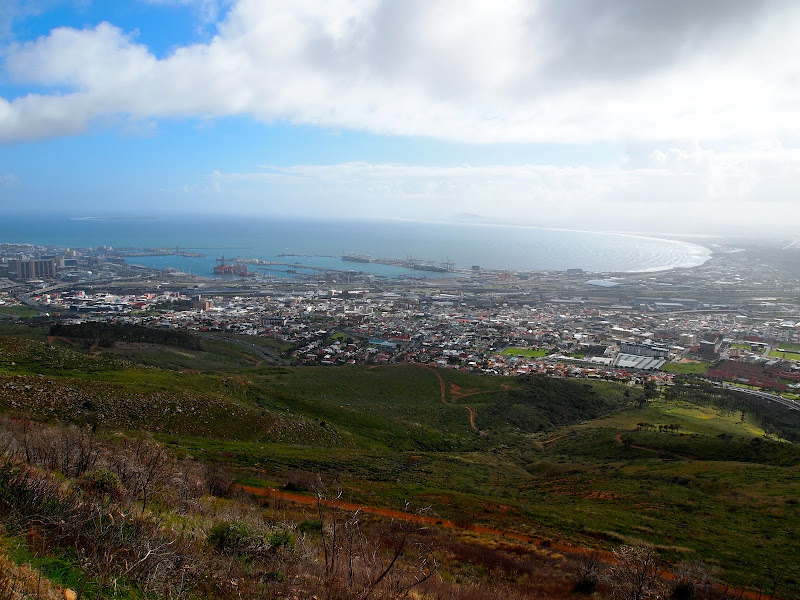
We've been early risers. At first, it was because we lived on a street that was loud, but the habit stuck. Julie and I are out of bed by six, and like to go jogging. This is a change for me, but Julie's been running for a while. I like the feeling I get from it. The neighborhoods are pleasant, and morning light is enchanted. Our best runs take us up on the side of Table Mountain, where wild flowers and low clouds grace the experience. As we round the final corner, we see the ocean beyond the city center.

We all eat breakfast together. The boys like a banana flavored cream of wheat called 'pro-Nutro'. I like a dense whole grain seed seed bread with peanut butter and chili jam. Chili jam is a real find, lekker (Afrikaans for good)! I've switched to tea; English breakfast with milk and sugar. Julie drinks Illy coffee and has a little 'double cream' yogurt with Cape Fruit. Breakfast is better here, as is most food.

View of the morning commute to the Grove Primary School.
We have to drive the kids to school. It's about 6 km. With traffic, this takes a total of 20 minutes. There's nothing like public radio here. Just hyper-commercial crap, which the kids have taken a liking to. There's nothing good about this routine, count one big one in favor of Missoula. I do miss the chill morning walks and bike rides to school with the neighbors.

Then comes work for me. As with in the US, I can walk. This is a very positive thing, something impossible to monetize, but worth 'a lot' to me. Here, it is 12 minutes, up a hill. I get into a good sweat, walking up the 291 stairs. Once there, there are few distractions, and I can focus on research. Overall, I miss some of the distractions. Teaching always provided me with something to escape from.  I do love the time and the focus, but don't know if I could sustain it for much more than a year. There is tea though, ten and two. Tea is social, and can last far too long.

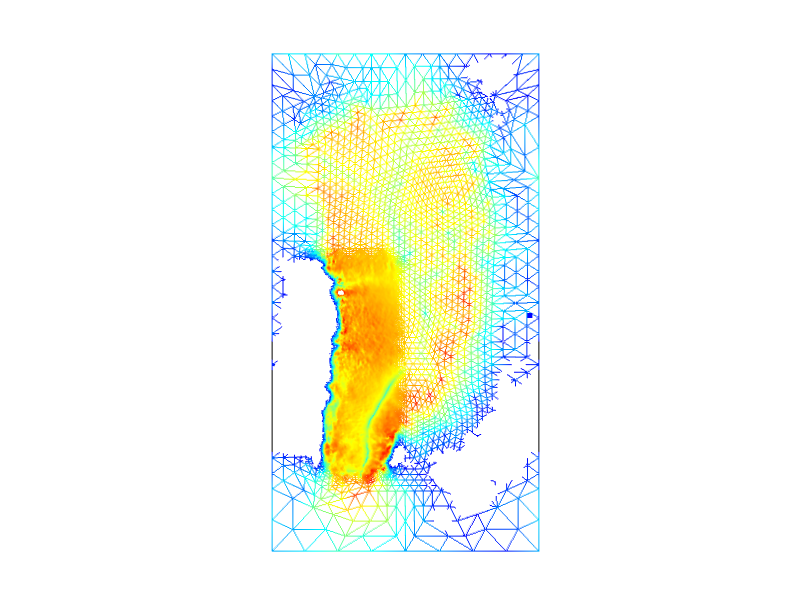
Speeds from a higher order momentum balance on an unstructured grid.
I should say something about what I've done. People ask, and it's sometimes embarrassingly hard to explain, and makes me feel like 'research' is a euphemism for surfing the internet. I've accomplished two things that are worth mentioning. First, I've got an ice sheet model that accounts for pushing and pulling of the ice that can occur down stream of flow. This would usually be the influence of the ocean. There are several ways to do this, but because at the heart of things, the physics is no longer strictly local, or linear, none of them are especially easy. I've elected to use one that is computationally efficient, robust, and supporting unstructured meshes. Amazingly (for me) it works. As is typical (for me) it took a long time to get here. Now I'm trying to compute the temperature of the ice. More months...

Drainage network analysis of Greenland.
I've also convinced myself that the surface morphology of Greenland, or the features on the surface that channel water downhill, are fundamentally different than the surface features that channel water downhill on land. Maybe that isn't very surprising, but as we begin trying compute the surface runoff of Greenland, or somewhere upwards of 50% of the mass loss, we will not be able to utilize the concepts that are used form computing runoff of overland flow. That could be significant.

Abe in chess club.
Abe playing in cricket. I have no idea why he's running.
Meanwhile...the kids are in a number of activities, and there's a fair amount of moving children around. Julie does most of this, and tells me that the social scene on the sidelines is pleasant, but the driving kids from place to place is awful. This counts as a big negative for Julie's routines. The kids probably like it better. Cricket!

Evenings are quiet and TV free. We're reading more, and the kids usually have homework. I love reading to the boys, and am very happy to be back in that routine. While I like the details of the evening routines a little better (reading instead of TV), the setting is not as nice. Home is home. The house here is perfectly acceptable, but not home. In the evenings I notice the lack of a comfortable bed, or couch, a favorite painting, or even a likable color of paint on the walls. A comfortable home is a nice thing to have, but you don't notice it until its gone (insert 80s ballad rock).

We do live for the weekends. I'm pleased to say that we've made some friends here, and treasure the time spent with them. South Africans are very open-hearted, hospitable, and accommodating people. Actually, the degree of hospitality they routinely show makes me  embarrassed about all the times I've dropped a visitor off at a hotel. South Africans are also curious about the world around them, and introspective about their unique experiences with apartheid and living in the most diverse country in the world. Getting to know them is a pleasure. As we've fallen into social routines, there's been a slight regret about not getting out to do more sight seeing. It has been all too easy to fall into poolside chats, pizza parties, braais, sushi dinners, and kids' birthday parties. All giving us an accomplished sense of having 'integrated' in a way, but diminishing our accomplishments as tourists. Oh well. If I'd wanted to be a tourist, I suppose I could have found the money to come here for a couple weeks a long time ago. In no particular order, a few of the highlights of our social life follow.

The top of Lion's Head with the Ramblers Club.
The kid's school has a 'Ramblers Club', or a group of parents and students that like to hike together. Wonderful group of people, and hiking is a nice way to meet folks. Here we are on top of Lion's Head on what would later be a full moon. On top, we enjoyed snacks and wine with the group. After sunset, the local astronomy club had a telescope and kids got to see the moons of Jupiter. The atmosphere after dark was very party like and social. Walking down was fantastic, the city lights inspiring a dizzying vertigo. Or was that the second hand ganja smoke?

Poolside in the summer.


A swimming pool is a fine thing in this climate. Here we are sitting around a friend's pool. There's a lot of activity. Dogs, kids, snacks, conversation, cell phones, and swimming. A terrific way to spend an afternoon.

Greenpoint stadium, wow, it's big.


We went to see the United States soccer team play Bafana Bafana (the boys), the South African national team. The venue was the 66,000 seat Greenpoint stadium, constructed for the 2010 World Cup. I'd never been to something like that, and am inclined to think that the value of an experience is inversely proportional to the number of people its shared with. But, what do I know? 65,999 people think otherwise. Vuvuzelas are loud, and one can't hear anything. Unlike what I've heard about the US, beers were only a couple of dollars, at the atmosphere was very upbeat. I liked it alright, and the kids liked it more.

Zach tells mom about putting chickens to sleep.
 To say we stay in Cape Town on weekends is a little bit of an exaggeration. We did get to the Whipstock farm a few weeks ago. This 'farm stay' has great hiking a short distance away. While staying in a cottage there, the hosts cook hearty country dinners and breakfasts, and the kids pet and feed the animals. There is a irrigation dam, and kayaks to use. Almond trees and citrus line the estate. Another very pleasant time.

And, that's life in South Africa lately. Next weekend we look forward to a ramble in an area north of here. Soon enough, we'll indulge in a (blog worthy?) long Christmas holiday. For now, the routine is feeling good. And it's summer, how can't you be happy in summer?