Sunday, January 30, 2011

Happy New Year

Back to school!
Happy new year to all. Presently, we find ourselves having finished five weeks of holiday. Now back in Cape Town, we've returned to school and work with a renewed sense of purpose. Five weeks was long enough to peer into the abyss that lies beyond this mortal coil. Naively one wishes for the unlimited beach and all that is associated with it; fine sunshine, cool water, rich feasts, care free days, play, and, allegedly relaxation. But when life delivers on this, experience begins to diverge from fantasy. One (or at least I) begins longing for the dull routine of work. The familiarity of surroundings and social contacts. The sense of accomplishing something, even if that something is make believe. In the end the experience was, if you'll indulge me; crystalline fragments of pure bliss, embedded in a gooey substrate of idleness. A summary follows.

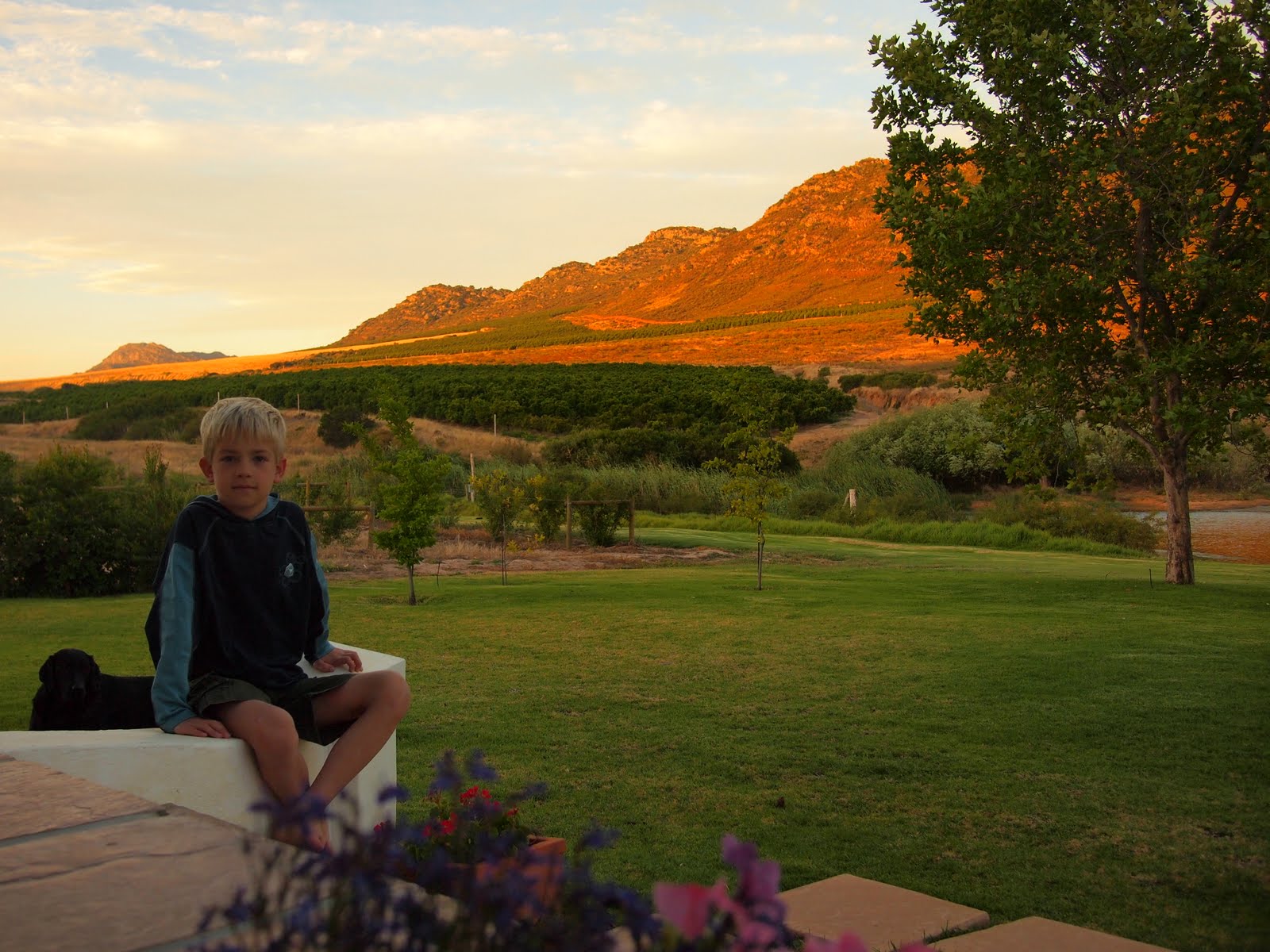
The Vermont cottage lies behind the dam and to the left.
Last you read, we had been to stay in a cottage in Citrusdal. Upon leaving there, we moved our life to a small town called Vermont. Named after the green hills visible from the town, this community is largely the result of the sprawl of beach homes that stretches out from the very popular resort town of Hermanus. We found an affordable cottage on a 'small holding' or estate of several acres in size. On the property, there was a small dam for swimming, and an enormous 'garden' (used the way we use 'yard') for playing.

Zach on the rocky coast near the cottage.
From our cottage, it was easy to walk to the coast, which in that area has a rocky, but attractive quality. Many small and fascinating creatures can be found in the pools left in the rocks at low tide, and kids carry small nets on the ends of sticks. 6 kilometers of well maintained coastal path made the morning jogs some of the best I've had. The area is very Afrikaans, and trail users greet you with a terse, 'mor-a'.

A short distance away from the cottage there were beaches with good swimming. One of our favorites was Ornus beach, where the Ornus river meets the ocean. The ocean can be intense, with its cold, powerful waves and stinging salt. A warm, fresh river to soak in was sometimes a welcome change.

Swimming in the ocean at Ornus beach.
We idled away the days on the beach, and occasionally would move inland, to some well developed hiking trails on the Fernkloof nature reserve. The wild flowers were putting on a good show, and we enjoyed a couple of pleasant walks.

As an indication of the social milieu that develops around a family spending so much time together, our most memorable experiences involved meeting friends who were also in the area. We hiked a few miles along a river to a secluded and refreshing swimming hole. We also did some horse back riding, and had a nice lunch with other friends.
Fernkloof flower; lanaria lanata

Another social outlet was provided by the owners of the cottage, who had us over on Christmas Eve. We had a fine evening, in what seemed to be a uniquely South African way. The dish that was most desired was the corned beef tongue. The family was Afrikaans, and very committed to the betterment of the country: running a charitable organization that promotes English literacy in Xhosa speaking families. They showed us the sort of hospitality that we've come to think of as normal here, but I still marvel over when I take a moment to think about it.

Hiking above Hermanus at the Fernkloof nature reserve.
Christmas itself was a quiet affair, with a few gifts, and, at Abe's insistence, some of the saltiest ham (called jammon here) I've ever had. Curiously, I think ham (or salt?) in those dosages can be something of a stimulant. I couldn't sleep at all that night.

Finally, our time there ended, and we returned to Cape Town to collect my father, who made the  long trip form South Dakota. So began another long and indulgent adventure, this time with more money being spent.

Abe climbing on rocks at 'Breakfast beach'.

We spent a few days in Cape Town, seeing the things that most agree one should see. This was somewhat tiring, as there is a fair amount of driving involved in going to all the sites in a few days. I think it was good, but I'm sure dad was mostly in a haze of jet lag.

For us, the trip took a turn for the better when we went to Franschhoek, and settled in for a few nights. Once there, our driving time was reduced to simple jaunts for meals or wine tasting. There was more time to relax and read, or enjoy one anothers company. I caught up with dad on some family business, and eagerly participated in his favorite pastime, arguing. Dad involved himself in the poolside tomfoolery that 7 and 9 year old boys invent.

Dining in Franschhoek.
I'm told by South Africans that Franschhoek has become an internationally recognized center for cuisine. I agree. Everything was superb, and the pairings of the wines with foods really adds to the enjoyment. I've never had it so good, I'm starting to think of wine as a staple, like bread. Always seeking to diversify the list of things I have consumed, I made some odd choices on the menus, opting for the suckling pig, and the lamb's liver. They were good, but it did seem that others did better with more conventional choices. Ah well, how many people can really say that they have experienced the finest liver possible? If you're curious, it still tastes like liver.


Waenhuiskrans, or (covered) wagon house cave, Arniston.
Dad's trip concluded in Arniston. Our friends  suggested we come and visit them at their cabin there, and experience the delights of the 'Arniston hotel and spa'. It was a very good suggestion. Arniston comes as close to some beach ideal as it gets, I guess. Very few people, very good service, warm and calm waters for swimming. I sort of get it, understand why people get so excited about this. But I still haven't figured out what I'm supposed to be doing at a beach resort.

Dad looking for octopus.
And that, friends, is all. You're very patient to make it through this account, I think it's more for my own memory than something people would be interested in reading. But, it was getting to be time for another post, and the holidays are the obvious thing to discuss. Soon I'll be teaching, and the daily events will be worth relating.

Monday, December 20, 2010

Christmas 4th of July Beach Party Mashup

Abe receiving his award at the end of year ceremony.
Abe and Zach began summer break two weeks ago. This was preceded by a week of the hearty self-congratulation that private schools excel at; picnics, awards ceremonies, and galas. On the whole, I still find it all pleasant. The weather has eased into a smooth trajectory through warm sunny days and cool nights. The holidays are coming, there's a certain buzz of familial emotion in the air. Shops are stocked with specialty meats, fudges, puddings, and cakes. The campus is abandoned, and the streets of Cape Town have lost some of their manic energy. The youth wear small clothing and big sunglasses. Somehow, all of this is familiar, but is triggering memories from several different times of the year, and at least one show that I saw once (ok, twice) on MTV. What was Jesus thinking, arriving on the longest day of the year? Right now, I'm having a hard time reflecting on anything deeper than my tan.

Leisure, here we come!
As pleasant as this backdrop may seem, there are hazards. Our routines are broken, there are no family or friends to fill the void. The requests for work from Northern Hemisphere colleges have slowed down. Left unattended, such periods of low stimulation can become distressing periods of listless boredom, quenched with mean spirited barbs, sibling combat, filial antagonism, and marital bickering.

But I don't want that. I've put my efforts into a serious and studied life of leisure. Not hard here, and perhaps becoming a recurring, even boring theme on this blog. What sorts of fun are the Johnson's up to now? New and different kinds of fun that you're going to love reading about!

Pomegranate cottage with pomegranate trees in foreground.
We celebrated the end of the school year by going to Citrusdal, which by car is some two hours north of Cape Town. We settled into 'the pomegranate cottage' which rests along the reservoir formed by a dam on a working citrus farm. The rhythms of the place were enjoyable; hot days and cool nights. Walks and runs were restricted to the mornings. Afternoons were reserved for swimming in the dam. Evenings we braaied over the coals of an open fire, then settled on a blanket under brilliant stars. All in all, a very good time.
We stayed cool by hiking up the creek bed.

I found the local nerd shop in Cape Town and bought the boys the 'Finland game of the year 2005'. As you might have guessed, what is big in Finland is usually pretty sweet. "Alhambra"; construct your Spanish wonder, impress the Sultan, manage your economy, crush your opponents. Something nice to do when not swimming.

There are some culturally interesting facts about the Ceaderburg /Citrusdal area. The land is primarily owned by Afrikaaners. Afrikaans is the the first language of most of the whites that live there. It's not a big tourist destination, the daytime temperatures are too high, and there isn't a lot to attract tourists. Without editorial, here are some observations (clues?) about the post-apartheid puzzle, as witnessed in Citrusdal:
Sunset posing, 'Merry Christmas, from the Johnsons'
Sunset from the stoop of the cottage.
  • A team of 5 Africans were cleaning out the Mrs' Mercedes when we arrived.
  • The workers quarters on this farm were some of the best I've ever seen, spacious and well kept. There were pleasant gardens, and satellite dishes on most. Nearby, there seemed to be a farm subsidized primary school and clinic. All very tidy.
  • The Mrs. told us about her children. One is attending public primary school in Citrusdal. The other has started attending a private boarding school in Stellenbosch. She says that the public secondary schools are no longer an option in Citrusdal, and the primary schools are deteriorating quickly. Public schools were adequate 15, even 10 years ago. One of the hazards of having a team of Mercedes washers is that their children will join yours at the public school. But I'm editorializing.
  • The Mrs. likes to hide behind some bushes near the house and steal a smoke when her husband is out. She's got a fluffy little dog that accompanies her.
  • All the land west of the approach is for the laborers to grow what they like on. Presumably they keep the profits. It looks to be mostly grapes and tea and is a big track of land.
Jump in!
I'll leave as an exercise for the reader how all of this will all work out. That's enough for now. In a few days, I'll fill you in on our Christmas plans.

Sunday, November 21, 2010

Routine

We are establishing routines.  I get satisfaction from this because the routines make us feel like we've successfully negotiated life in South Africa. We go to school and work, pay bills, exercise, socialize, and relax. Our routines here are different from those we had in the United States. Sometimes for the better, other times for the worse. In this post I report on our routines, and how they make us feel.

A view from the trail we've been jogging on.
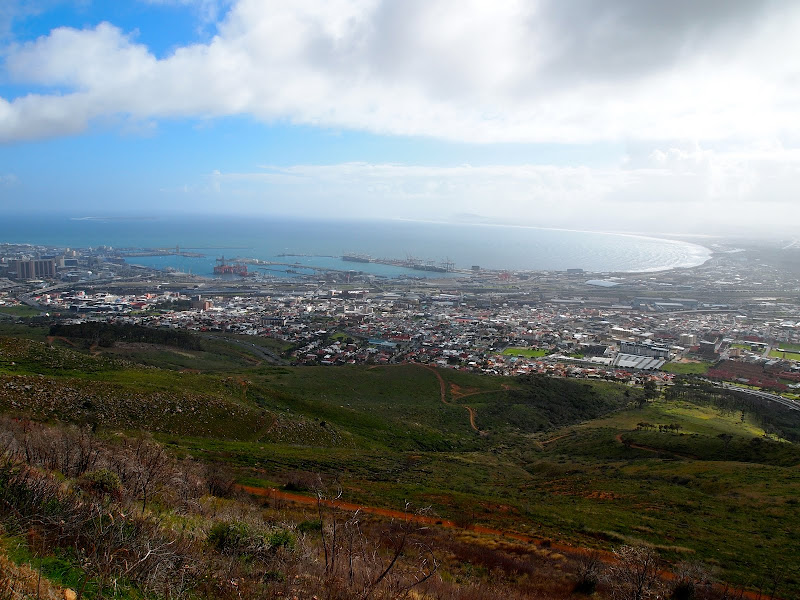
We've been early risers. At first, it was because we lived on a street that was loud, but the habit stuck. Julie and I are out of bed by six, and like to go jogging. This is a change for me, but Julie's been running for a while. I like the feeling I get from it. The neighborhoods are pleasant, and morning light is enchanted. Our best runs take us up on the side of Table Mountain, where wild flowers and low clouds grace the experience. As we round the final corner, we see the ocean beyond the city center.

We all eat breakfast together. The boys like a banana flavored cream of wheat called 'pro-Nutro'. I like a dense whole grain seed seed bread with peanut butter and chili jam. Chili jam is a real find, lekker (Afrikaans for good)! I've switched to tea; English breakfast with milk and sugar. Julie drinks Illy coffee and has a little 'double cream' yogurt with Cape Fruit. Breakfast is better here, as is most food.

View of the morning commute to the Grove Primary School.
We have to drive the kids to school. It's about 6 km. With traffic, this takes a total of 20 minutes. There's nothing like public radio here. Just hyper-commercial crap, which the kids have taken a liking to. There's nothing good about this routine, count one big one in favor of Missoula. I do miss the chill morning walks and bike rides to school with the neighbors.

Then comes work for me. As with in the US, I can walk. This is a very positive thing, something impossible to monetize, but worth 'a lot' to me. Here, it is 12 minutes, up a hill. I get into a good sweat, walking up the 291 stairs. Once there, there are few distractions, and I can focus on research. Overall, I miss some of the distractions. Teaching always provided me with something to escape from.  I do love the time and the focus, but don't know if I could sustain it for much more than a year. There is tea though, ten and two. Tea is social, and can last far too long.

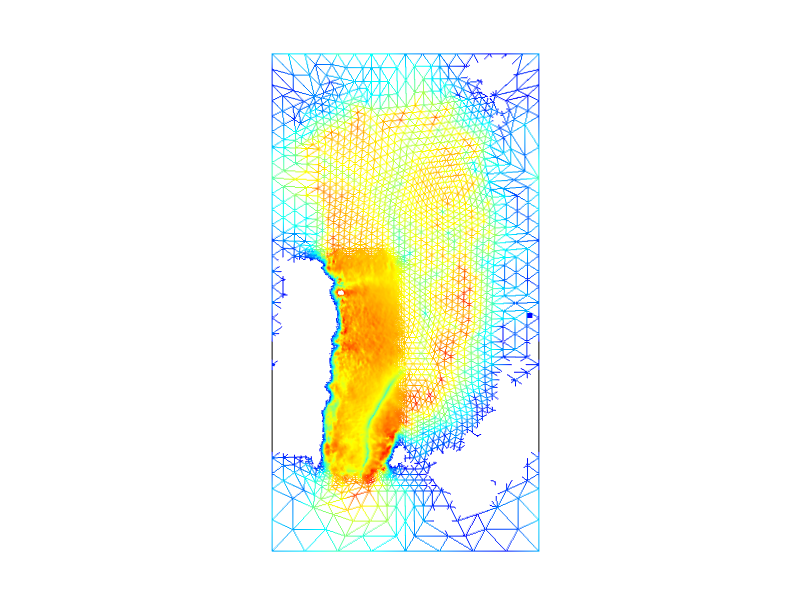
Speeds from a higher order momentum balance on an unstructured grid.
I should say something about what I've done. People ask, and it's sometimes embarrassingly hard to explain, and makes me feel like 'research' is a euphemism for surfing the internet. I've accomplished two things that are worth mentioning. First, I've got an ice sheet model that accounts for pushing and pulling of the ice that can occur down stream of flow. This would usually be the influence of the ocean. There are several ways to do this, but because at the heart of things, the physics is no longer strictly local, or linear, none of them are especially easy. I've elected to use one that is computationally efficient, robust, and supporting unstructured meshes. Amazingly (for me) it works. As is typical (for me) it took a long time to get here. Now I'm trying to compute the temperature of the ice. More months...

Drainage network analysis of Greenland.
I've also convinced myself that the surface morphology of Greenland, or the features on the surface that channel water downhill, are fundamentally different than the surface features that channel water downhill on land. Maybe that isn't very surprising, but as we begin trying compute the surface runoff of Greenland, or somewhere upwards of 50% of the mass loss, we will not be able to utilize the concepts that are used form computing runoff of overland flow. That could be significant.

Abe in chess club.
Abe playing in cricket. I have no idea why he's running.
Meanwhile...the kids are in a number of activities, and there's a fair amount of moving children around. Julie does most of this, and tells me that the social scene on the sidelines is pleasant, but the driving kids from place to place is awful. This counts as a big negative for Julie's routines. The kids probably like it better. Cricket!

Evenings are quiet and TV free. We're reading more, and the kids usually have homework. I love reading to the boys, and am very happy to be back in that routine. While I like the details of the evening routines a little better (reading instead of TV), the setting is not as nice. Home is home. The house here is perfectly acceptable, but not home. In the evenings I notice the lack of a comfortable bed, or couch, a favorite painting, or even a likable color of paint on the walls. A comfortable home is a nice thing to have, but you don't notice it until its gone (insert 80s ballad rock).

We do live for the weekends. I'm pleased to say that we've made some friends here, and treasure the time spent with them. South Africans are very open-hearted, hospitable, and accommodating people. Actually, the degree of hospitality they routinely show makes me  embarrassed about all the times I've dropped a visitor off at a hotel. South Africans are also curious about the world around them, and introspective about their unique experiences with apartheid and living in the most diverse country in the world. Getting to know them is a pleasure. As we've fallen into social routines, there's been a slight regret about not getting out to do more sight seeing. It has been all too easy to fall into poolside chats, pizza parties, braais, sushi dinners, and kids' birthday parties. All giving us an accomplished sense of having 'integrated' in a way, but diminishing our accomplishments as tourists. Oh well. If I'd wanted to be a tourist, I suppose I could have found the money to come here for a couple weeks a long time ago. In no particular order, a few of the highlights of our social life follow.

The top of Lion's Head with the Ramblers Club.
The kid's school has a 'Ramblers Club', or a group of parents and students that like to hike together. Wonderful group of people, and hiking is a nice way to meet folks. Here we are on top of Lion's Head on what would later be a full moon. On top, we enjoyed snacks and wine with the group. After sunset, the local astronomy club had a telescope and kids got to see the moons of Jupiter. The atmosphere after dark was very party like and social. Walking down was fantastic, the city lights inspiring a dizzying vertigo. Or was that the second hand ganja smoke?

Poolside in the summer.


A swimming pool is a fine thing in this climate. Here we are sitting around a friend's pool. There's a lot of activity. Dogs, kids, snacks, conversation, cell phones, and swimming. A terrific way to spend an afternoon.

Greenpoint stadium, wow, it's big.


We went to see the United States soccer team play Bafana Bafana (the boys), the South African national team. The venue was the 66,000 seat Greenpoint stadium, constructed for the 2010 World Cup. I'd never been to something like that, and am inclined to think that the value of an experience is inversely proportional to the number of people its shared with. But, what do I know? 65,999 people think otherwise. Vuvuzelas are loud, and one can't hear anything. Unlike what I've heard about the US, beers were only a couple of dollars, at the atmosphere was very upbeat. I liked it alright, and the kids liked it more.

Zach tells mom about putting chickens to sleep.
 To say we stay in Cape Town on weekends is a little bit of an exaggeration. We did get to the Whipstock farm a few weeks ago. This 'farm stay' has great hiking a short distance away. While staying in a cottage there, the hosts cook hearty country dinners and breakfasts, and the kids pet and feed the animals. There is a irrigation dam, and kayaks to use. Almond trees and citrus line the estate. Another very pleasant time.

And, that's life in South Africa lately. Next weekend we look forward to a ramble in an area north of here. Soon enough, we'll indulge in a (blog worthy?) long Christmas holiday. For now, the routine is feeling good. And it's summer, how can't you be happy in summer?

Tuesday, October 19, 2010

Spring Break

Gearing up for safari in Addo elephant park.
It's spring now, and a recent spring break for the boys was a welcome, if slightly awkward surprise. Awkward in the sense that up until then, we had spent what I thought was a fair amount of time getting settled, and the regular rhythm of life was feeling good. We made the best of it and set out for Addo elephant park, home to the highest density of elephants in the world.

'Brenton on the sea' was the name of this beach.
The park is some ways away, and while I love the Tazz, it's not much of a highway cruiser. Big cars, like the van we had in the US, diffuse sibling conflict. Small cars concentrate it. Add the lack of cruise control, and the constant shifting of gears to get up hills, and I was only up for about 5 hours of driving a day. So, we stopped and camped at a place called Lake Pleasant. It was plenty pleasant, and our first camping experience here. Easy car camping, but lacking the familiar picnic table, we had a hard time managing our cooking. Lake Pleasant is near the beach, which is always nice to visit.

Poolside at the Avaco farm stay.
The next day we drove on to Addo, where we stayed on a citrus farm. I suppose I should come to the point: It was wonderful. First, the weather was enjoyable; hot days, and cold nights, the area is arid and low latitude. This could be uncomfortable, but when managed with appropriate technology, it's very fine indeed. A pool and a pond to while away the warm afternoons. A light sweater and a roaring fire for the cool evenings.


High risk, high reward behavior. Exhibit one: no life jackets!
I appreciated several things about the citrus farm.  First, there were kayaks and canoes to navigate the river with.


Exhibit two: the trampoline.

Second, there were two trampolines for the boys to jump on. Hours upon hours were spent jumping.


Exhibit three: the zip line.

 Third, there was a zip line for the kids to whiz down.

At some point it occurred to me that the whole affair was unsafe, and would never be
acceptable in the United States. This made it all the sweeter, as fun seems to have been a casualty of the American campaign for safety. A campaign that recognizes that broken arms can be monetized, but 'fun' can not.

I'm going speculate that South Africans have a different attitude about safety because they are more familiar with genuine risk; like life threatening crime.
A long evening of braai nearing completion.
Finally, I love braai. This is the South African way of barbecuing. An open flame is required, and a braai area consists of a wide circle of concrete on which to burn wood, with seats arranged around the fire. Wonderful ambiance, and a hearty roasted meat conclusion. Add bright Southern constellations, a glass of wine, and cool air, and you've really got something. "All units at the Avaco farm stay have Braai facilities." This is typical SA marketing language.

Our cottage.
Moreover, there were birds to look at, and trails to walk. The breakfasts were delicious, the locals were friendly, and the surroundings were foreign enough to be interesting.  Spring time is when citrus are blooming, and rich sweet smells permeated the cool morning air that clings to the ground. The cabins were clean with a well thought out floor plan. A small orchard was reserved for guests and lemonade or fresh squeezed orange juice was served constantly.  I sometimes feel like a travel failure, when I find a nice place and settle in for a week. Looking at the travel guide,  there are a half dozen 'must do' things in the area and I'm quietly missing them all. Oh well, I thought being a slacker was the point of holidays, honestly, seeing everything in the travel guide is just too much trouble.

Cape Buffalo.
Incidental to the time we had staying at the citrus farm, we went out on safari in the elephant park. Not surprisingly, we saw elephants. We also saw a buffalo, ostrich, wart hogs,  foxes, and a dung beetle. Not a bad couple days viewing. It is nice to do, but its relevance decreased as the days went by, and we enjoyed our stay on the farm more and more.


Abe holding a baby lion.
Finally, there was a cat breeding farm that we visited. I think the picture tells you what you need to know. It was as fun as it looks, maybe more. You wouldn't believe the sounds baby lions make.

A final note: I managed to find a good book to read while there. Have a look at Freedom, by Johnathan Franzen. There's plenty to think about in that book.

Monday, October 4, 2010

The Grove Primary School

The Grove Primary School
In South Africa, publicly funded schools can charge fees. The public money means that they are able to charge less than a completely private school, but the fees enable them to offer more than a completely public school. For instance, our school has 50% of the funding coming from the government, and 50% from fees. Schools such as this are designated as 'class C schools' in South Africa.

In the American system, I think that a similar idea was discussed under the moniker 'school vouchers'. So far as I know, the proposed voucher systems did not allow as much curriculum standardization as the South African model, where in order to receive public funds schools must include things like some instruction in indigenous African languages (Xhosa in the Western Cape) and Afrikaans, a Dutch derived language spoken by the descendants of the earliest white settlers. Students are also getting a balanced introduction to religious beliefs including; Islam, Christianity, Hinduism, Judaism, and African animist beliefs. Contrast that to the voucher system proposed in the United States, where the purpose was often, in my view, religious indoctrination.

For that reason, and others, I never really supported the voucher concept.  I guess I also believed it would lead to deeper inequities, as the people that could afford to pay more would, and leave others behind.

But those were the thoughts of a younger man, one that didn't actually have children to put his theories to test on. Now, as I participate in a system where I can use financial resources to provide my children  an advantage, I have to ask myself, "am I getting $2000 a year back in terms of each child's education?"  Sadly, the answer is, "YES". I wish that weren't the case. I wish that our public education system were this good and better, I'll be returning to it soon enough. But I don't think it is. Let me try and explain why.

Student art. Good colors make all the difference.
First, there is an art program. We don't have one in the Montana, programs have been cut to provide more funding for the basics; reading, writing and arithmetic.  Here, there is a dedicated art teacher, an art room, and the a culture that strongly supports the arts in school. Students spend at least one hour a week working on art projects with the teacher. She's talented. I have to admit, I'm not sure the experience would be universal without such a good teacher. She's a strong personality and tolerates no nonsense from the students. She has managed to create a culture at the Grove where students are serious about doing a good job on art projects. They work in after hours art clubs, and our boys continue many of the projects at home.

Recently, there was an art auction fundraiser at the school. Wine was served, and we were all asked to bring a plate of hors d'oeuvres. Smartly dressed seventh graders served the food, while we bid on art, looked at art, drank wine, and talked to parents.

Art auction
There is a technology class where students work with light tools to create metal and wood works. I suppose we called this 'shop', but didn't get to it until seventh grade. I think it is another creative outlet for students. Maybe more appealing to students that aren't artistically inclined? Abe's been really interested in 'French Knitting'.

I like the math curriculum.  For instance, students are asked to find a way to combine 2, 5, 3 and 7  with multiplication, division, addition and subtraction to be 24 (3 x 7 + 5 - 2 works). The emphasis is on numeracy rather than memorization. There are also a lot of nice exercises based on estimation, and orders of magnitude. Very good!

In spite of uniforms, these kids look like punks.
Uniforms are undeniably cute. And maybe serve a purpose. The boys like to wear them, I think because they think they look good in them. At the end of the day, I think it's nice to have that stress off the table. There's plenty enough to worry about at school, without getting into football jerseys or rock band tee-shirts.

Music is a positive experience at the Grove. Many opportunities exist for lessons in piano, violin, recorder, etc. right in school. And a regular program for music that has our kids interested in singing and playing instruments. Somehow this never happened in the States, the program there turned our kids off to music. I always thought that was weird, a music program that kids don't like. Kids seem to naturally love music.

Zach in front of a grizzly dino scene.
Among other things, students get a grade for 'hygiene'. I've got the boys brushing their teeth every morning and getting regular haircuts with simple threats about hygiene grades. Sadly I'm still very much in the "threats" school of parenting. But, guess what? They are having a workshop at the Grove to help us with that. Not sure I'll make it, but hopefully there's a synopsis in the newsletter.

The emphasis on handwriting turned me off at first but I've come around. It's helped Zach stop reversing 'b' and 'd's, 'p's and 'q's, and as a result (maybe?) his reading has improved. His reading has definitely taken off, but its hard to attribute it to any one thing. There are educational benefits to being a foreigner, not wanting to embarrass yourself in a new culture, that's sure to play a role too. OK, I'm in the "humiliation" school of parenting too. Threats and humiliation.

The obelisk marks the location where Hershel observed the southern skies.
The school grounds are spectacular. Mostly open space for playing. The school sits on the site where Hershel came to observe stars in the Southern Hemisphere. There's also a family of Egyptian geese. All the students seem to know how many goslings there are and how the goose and gander can or cannot be crossed.

Zach and class on a field trip to the museum of natural history.
Field trips, or excursions are common. It's nice to live in a big city, I'm  sure it would be similar in any big city.  

There's a newsletter filled with the issues of the day. Recently, it's been dropping students off. No stopping cars in the red zone! They had the police come and issue some 40 odd tickets. It's good to see people fired up about silly shit. Makes me think the political situation can't be all bad. Then again, there have been efforts to eliminate class C schools in South Africa. I suppose I see where that comes from, equality of educational opportunity is a core democratic value. But as it is now, the Grove goes out of its way to provide a lot of scholarships to economically disadvantaged students. I can't see that continuing if public funding stopped.

The family of Egyptian Geese have their own pool.
Finally, and I'm a little uncomfortable saying this, it's nice to be in an environment where everyone cares about education. The peer group is outstanding, and our children have moved to the middle of the pack, instead of the front. The most disruptive personalities in US classrooms are not present. They are certainly here in South Africa, no society is free of that. But I don't believe that their parents are willing to  pay that much for school, because I don't think they care enough to. Alternatively, I suppose you could say that they are victims of circumstance and can't afford to pay that much. And so why visit the sins of the father on the son? Fair enough, public education should serve the public. But in America, I don't think it is so much a matter of money, but instead of priorities, and I guess I'd like to stay clear of people with really different priorities. Bummer, that's not a healthy society.

Thursday, September 23, 2010

CEREMCAM People: Patrick

I'd like to use some of these blog posts to highlight  my CERECAM colleagues. They are very interesting, talented academics. I'll begin with Patrick, who I've found easy to talk to.

Patrick is from Nigeria, having lived in both Ileife and Lagos. It's a shame that the world knows Nigeria mostly by the following export:

"Dear Sir,
Good day to you
My name is Joey Jones i am an American soldier, i am serving in the military of the 1st Armored Division in Iraq. I am now in Kuwait in the mean time, I and my partner moved funds belonging to Saddam Hussein, the total is (Twenty Five million US dollars) this money is being kept safe in a security company. Click on this link to read about even that took place here:
http://news.bbc.co.uk/2/hi/middle_east/2988455.stm


Basically since we are working for the American government we cannot keep these funds, but we want to transfer and move the funds to you, so that you can keep it for us in your safe account or an offshore account..."
Patrick in his office.
The 419 (or sometimes 411) scam, named after the relevant sections of Nigerian criminal code, has netted Nigerians some 5 billion dollars since the early eighties. Some estimate that it ranks as between the third and fifth largest revenue sources for Nigeria. Working on the premise that you really can't cheat an honest man, the scam apparently works on traditional Nigerian beliefs. Patrick tells me that in Nigeria a hand bag or even a wallet left carelessly in a car is quite safe. Instead people believe that one must "trick" people out of their possessions by exposing their moral failures.

At any rate, 419 scams are a shame, because there is much more to Nigeria. I've been fascinated with the stories Patrick tells me, here are a few examples.

The Nigerian people are very friendly and love to welcome and make people feel at home. This is a projection of the good qualities of the culture, and is completely genuine. However,  Nigeria is the most densely populated country in Africa and the fears associated with big city living, poverty, and inequity all work against Nigerian's welcoming nature. Patrick tells me that the open heartedness is much harder to encounter after dark. Personally, I don't know anything about Nigeria, but I would agree there is a welcoming nature in the parts of Africa I've been to.

Communication is easy in Nigeria, English is spoken nearly everywhere. The cost of living is low and quality of of life is high. Living expenses for a small family are typically less than $100 dollars per month. There are tremendous recreational opportunities; including beaches, natural history and cultural museums. Consumer goods are not taxed because oil revenues offset taxes. However, economic potential is wasted due to inconsistent electricity supply. A funny story Patrick told me was that he avoided studying computation because the power supplies were simply too inconsistent. So instead he does theory of the sort that can be done with pencil and paper.

Nigeria has a rich history and culture. It's a disservice for me to try and account for all of it, I really don't know much, but Patrick mentioned the Ife bronze head, an extraordinary piece of metal working skill, dating back to the end of the first millennium. He also told be a couple Yoruba proverbs, and I always like proverbs. 

In the presence of elders the head of the baby is straight.
Straight head?
Which is to say that things become easier in the presence of experienced people. Here the straight head refers to the position of a baby, riding on his or her mother's back. This is a common way to transport babies throughout Africa, when the head leans to far to one side or the other, it just can't be a good thing.


The laminar object that goes up, will come down.
By Patrick's account, this is saying that situations that are tough will eventually resolve.  I can see that, although that's not how I would interpret the American proverb, 'what goes up must come down'. I love that the object is laminar, as in layers, I think? 

Finally, I read a history of the Biafra wars not long ago, and it really was eye opening. My take would be its a classic case of an economically dominate ethnic minority literally being killed for their status. After much genocide, that minority (the Igbo) tried to form an independent state, Biafra, and that's the Biafran war. They lost, and Nigeria is Nigeria. The Igbo, Patrick tells me are famous business men throughout Africa. Unfortunately they do not always make their business selling things that are legal

A page from Patrick's notebook.
In terms of academic interests, Patrick works in applied math. Presently, he is proving theorems about a certain class of non-differentiable contact problems, essentially, demonstrating that solutions exist. Beyond that, Patrick is looking critically at the issue of regularization, and determining if it is indeed justified. Patrick has done a bit of teaching, and finds that he likes it, especially when the students are clever.

Finally, Patrick is a true intellectual, with tastes in arts and culture that are incredibly sophisticated. He reads classical literature (Toni Morrison, Sula, Faulkner, Sound and Fury, James Joyce, Ulysses), listens to jazz (Avishia Cohen, John Coltrane, Miles Davis, Winton Marsalis) twentieth century classical music (Rachmaninoff, Prokofiev, Debussy, Ravel),  and is an accomplished  online chess player.

Phew, it all makes me feel like a little bit of a heathen. It's  good that Patrick has also seen a few episodes of CSI, and likes the movies of Leonardo DiCaprio. Otherwise, we wouldn't have much to talk about. But I'm working to corrupt him. I think I'll give him a few episodes of Deadwood to watch, and a TV on the Radio CD to listen to.

Wednesday, September 8, 2010

Work

My pass
I am a visiting academic at the University of Cape Town. See, it even says so on my identification card. Access to buildings on campus is tightly controlled with these cards. I assume it has some sort of RF ID chip, in addition to a magnetic strip on the back.


Jameson Hall
The University has about 23,500 students. Founded in 1829, it is South Africa's oldest college. I am finding it to be much the same as other campuses I've been on. Walk around and you'll see 18-25 year old people, out in courtship display. The campus has a bar; one of those impossibly grown up things we don't have on American campuses anymore. Some of the major halls are named after characters of dubious integrity. Like the centrally located Jameson Hall (right). At Cecil Rhodes' instigation, Jameson led a military fiasco to take the gold mines of Johannesburg from the Boers. It seems that Rhodes and company were so used to stealing from African tribes, they couldn't imaging that looting one more would be much trouble. Even if it was a tribe of Dutchmen. Look at the stairs. The campus is built on a hill side, I counted 291 stairs on the way to my office.

Smuts Hall
Then again, some buildings are named after people I like, such as Jan Smuts. In my opinion, he was a fair, intelligent, and resolute man. He was among the first of the Afrikaners to recognize that Africans were a fact of African life, and ignoring or denigrating them was not  helpful.  He also humiliated the British military machine during the second Boer war. To the left is a picture of his hall. Typical of many of the buildings, with a courtyard and ivy covered walls.


CERECAM
I am working in a place called 'Center for Research in Computation and Applied Mechanics', or CeReCAM. Folks here know a lot about the finite element method, and non-linear materials. Two things that are useful in my research. CERECEM has a special (access controlled) door; very professional. I feel like I'm  part of something good working here. Much of the center's activities are in service of engineering goals, which lately appeal to me. I'm not sure I'm going to determine what sea level will be in 100 years, but darn it, I probably could have figured out a better angle to graft a vein at for a bypass, or separate good from bad mine tailings. Ah well, if I never managed a 'misspent youth', I definitely have a leg up on the 'misspent career' thing.

A place to call "the office", I need that in my vocabulary.
Here is my office, and me. Even though it's spring here, I'm growing my fall beard. I suppose I'm confused. You can't see it in the picture, but that internet cable admits only the thinnest trickle of internet stuff. This is a problem.

Bad ice sheet model.


And here is a picture of what I've been working on. As the ice flows into a region where there is melting, the surface should lower. That's what melting does to glaciers. In my model, large amounts of melting can lead to the surface crossing over the bed.  That's bad, it crashes the model, and I'm trying to stop it. Finding a solution is taking longer than I'd like, but at least I know what I'm trying to accomplish. Nothing takes the amount of time I'd like it to. Not even in South Africa.